
Solar System: An Overview
Solar System
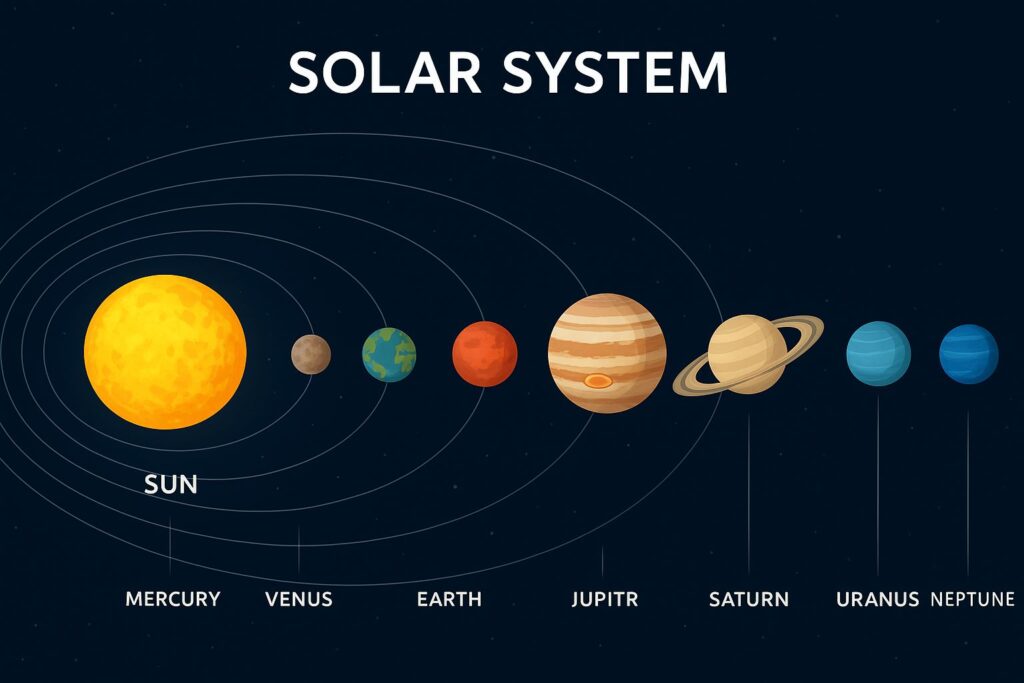
The Solar System is a large and structured collection of celestial bodies including the Sun, eight planets, dwarf planets, moons, asteroids, comets and space dust. It is located in the Milky Way galaxy and plays a key role in understanding cosmic evolution and astronomy.
1. The Sun – Central Star
The Sun is the center of the Solar System and holds all planets in orbit through its strong gravitational force. It generates heat and light through nuclear fusion.
- Type: G2V Yellow Dwarf Star
- Diameter: ~1.39 million km
- Importance: Primary source of energy for all planets
2. Formation of the Solar System
The Solar System formed approximately 4.6 billion years ago from a giant rotating cloud of gas and dust. This process is known as the Nebular Theory.
3. Classification of Planets
There are eight planets categorized as inner rocky planets and outer gas giants.
Inner Rocky Planets
| Planet | Key Features |
|---|---|
| Mercury | Smallest; closest to Sun |
| Venus | Hottest planet; thick CO₂ atmosphere |
| Earth | Only planet supporting life |
| Mars | Red Planet; evidence of ancient water |
Outer Gas & Ice Giants
| Planet | Type | Features |
|---|---|---|
| Jupiter | Gas Giant | Largest planet; Great Red Spot storm |
| Saturn | Gas Giant | Prominent ring system |
| Uranus | Ice Giant | Rotates sideways |
| Neptune | Ice Giant | Strongest winds in Solar System |
4. Dwarf Planets
Known dwarf planets include:
- Pluto
- Ceres
- Eris
- Makemake
- Haumea
5. Moons
Moons are natural satellites that orbit planets. Some famous moons include:
- Earth’s Moon: Controls tides; stabilizes Earth
- Ganymede (Jupiter): Largest moon
- Europa (Jupiter): Believed to have subsurface ocean
- Titan (Saturn): Thick atmosphere similar to early Earth
6. Asteroids & Belt
Asteroids are rocky objects mostly found between Mars and Jupiter.
7. Comets
Comets are icy bodies that form glowing tails when near the Sun.
8. Meteoroids, Meteors & Meteorites
- Meteoroids: Small rocks in space
- Meteors: When entering atmosphere (shooting star)
- Meteorites: When they reach Earth surface
9. Planetary Orbits
All planets revolve around the Sun in elliptical paths. Farther planets take longer to complete one orbit.
Conclusion
The Solar System is a well-organized and evolving celestial structure that helps us understand the universe, planetary formation, and the potential for life beyond Earth.
🌌 PERITT Solar System Expert
Ask me anything about the Solar System!
Quick Questions:
🌟 Solar System Quiz
Test your knowledge of space and astronomy